


It was 11:47 on a Tuesday when the sales manager at a mid-sized software company realized the problem. Her team had spent the quarter chasing 4,000 new leads a number that looked impressive in the weekly dashboard. But when she asked her reps to pull their actual pipeline, the conversations that mattered could be counted on two hands. The rest was noise: bad contact data, prospects who would never buy, and follow-up emails that vanished into inboxes already full of autoresponder replies.
She wasn't alone. Across industries, businesses have been sold a story about lead generation that sounds logical but quietly destroys revenue: more leads equals more opportunity equals more sales. The math only works if you don't count the hours your team spends sorting through the wreckage.
The contrarian truth, backed by practitioners who have rebuilt their pipelines from the ground up, is simpler and harder: the goal was never more leads. The goal was always the right leads, flowing through a system designed to capture, score, and route them before your team ever sees them.
What a Scalable Lead Generation System Actually Is
The phrase "lead generation system" gets used so broadly it has nearly lost meaning. A landing page is a system. A LinkedIn outreach sequence is a system. A trade show follow-up process is a system. But most of these pieces, taken alone, don't scale they accumulate.
A scalable lead generation system, as practitioners describe it, is something different. It's an integrated infrastructure where every prospect is scored, routed, and handed off without your team asking where did this come from? The emphasis on structure isn't bureaucratic it's practical. When a lead arrives from a chatbot on your pricing page, your team should know that before they pick up the phone. When an outbound sequence generates a reply, the response should route to the right rep automatically.
The distinction matters because it separates two kinds of lead generation activity. The first is capture getting contact information from someone who showed interest. The second is qualification determining whether that person is worth your team's time. Most businesses do the first part reasonably well. The second part is where pipelines either become revenue engines or become graveyard databases full of contacts that will never convert.
According to the BulkLeads guide to lead generation systems, the infrastructure that actually fills a pipeline is built for revenue teams who need qualified inbound and outbound leads not vanity metrics. That framing matters. The goal isn't to look busy. The goal is to move a prospect from first touch to closed deal through a measurable journey.
The Contrarian Case Against Lead Volume
Here is the uncomfortable arithmetic most marketing reports don't show: a sales rep can meaningfully engage with perhaps 20 to 30 prospects in a given week. If your lead generation system delivers 500 names, 470 of them will sit untouched. Your team will either ignore them which means your marketing spend produced nothing or they will half-heartedly email them in bulk, which produces low reply rates and poisons your sender reputation.
The contrarian read on lead generation is that volume, without qualification infrastructure behind it, is a liability. It creates work that doesn't produce revenue. It fills your CRM with data that decays within months. It trains your team to expect that leads are cheap and plentiful, which makes them less likely to treat each conversation as the scarce resource it actually is.
Practitioners who have rebuilt their pipelines describe a common pattern: they started with a volume-first approach, watched their cost per acquisition climb, and then rebuilt around qualification. The rebuild typically involves three changes. First, they added lead scoring assigning points based on behavior, company size, or stated intent. Second, they built routing rules so that high-scored leads went directly to senior reps while lower-scored leads entered a nurture sequence. Third, they connected every touchpoint to a revenue event, meaning they could trace a closed deal back to the first email, the first chatbot interaction, or the first form fill.
The result, when done well, is a smaller number of leads that actually convert. That sounds like a failure of ambition. In practice, it's a multiplication of revenue per hour spent.
Building a Scalable Lead Generation System
Constructing a system that scales without creating noise requires thinking about four interconnected layers: capture, enrichment, qualification, and routing. Each layer has its own tools and its own failure modes.
Capture: Stop Losing Leads to Scattered Forms and Dead Chats
The first problem most businesses discover is that their leads are scattered. A visitor fills out a form on the pricing page. Another sends a message through a chatbot. A third replies to a cold email. These interactions live in different systems if they live anywhere at all. The result is that no single person in your organization has a complete picture of a prospect's journey.
Unified capture solves this by routing every inbound touchpoint into one pipeline with full source attribution. When a prospect fills out a form, the system tags the source: paid search, organic, referral, outbound sequence. When a chatbot captures a visitor's email, that contact enters the same pipeline with the chatbot interaction logged. The attribution matters because it tells your team not just who the prospect is, but how they found you which shapes the conversation that follows.
Modern capture tools include chatbots that can be customized by scenario, color, and position. The BulkLeads chatbot solution, for example, can be installed to capture information from visitors, with collected lead data sent by email, SMS, or directly into a Slack channel. This kind of flexibility matters because different businesses have different follow-up workflows. A chatbot that dumps leads into a generic inbox without routing is only half solving the problem.
Enrichment: Filling the Gaps That Kill Conversations
Raw capture gives you a name and an email. Enrichment gives you a reason to call. The enrichment layer pulls additional data company size, industry, job title, recent funding, technology stack and attaches it to each contact record. This context transforms a cold introduction into a relevant one.
Practitioners describe enrichment as the layer that separates professional lead generation from amateur list buying. A raw list of 10,000 emails might cost less than an enriched list of 1,000, but the enriched list produces more conversations because your team knows who they're reaching and why.
Tools like the BulkLeads lead enrichment platform allow teams to fill missing emails and firmographics from company lists. The workflow is straightforward: upload a list of companies or contacts, the system appends data, and your team works from enriched records more than bare contact information. The difference in conversation quality is immediate.
Qualification: Stop Feeding Your Pipeline Noise
Qualification is where most lead generation systems either prove their value or reveal their flaws. The goal, as practitioners frame it, is to route only sales-ready prospects into your pipeline not time-wasting noise. This sounds obvious. In practice, most businesses route everything, trusting their sales team to sort the signal from the static.
That trust is expensive. Every hour a rep spends on an unqualified lead is an hour not spent on a prospect who was ready to buy. Qualification frameworks vary, but the most effective ones combine behavioral signals (did the prospect visit the pricing page? did they open multiple emails?) with demographic fit (company size, industry, budget authority). The combination produces a score that determines routing: high scores go to sales, medium scores enter nurture, low scores are suppressed or recycled.
The discipline required here is cultural as much as technical. Sales teams often resist qualification because they fear losing leads. Marketing teams often resist qualification because their metrics are built around volume. Building a system that works requires aligning both teams around a shared metric: revenue per lead, not leads per campaign.
Routing: From Touchpoint to Revenue Event
The final layer is routing the system that determines what happens after a lead is captured and qualified. The best routing systems are invisible to the prospect and obvious to the team. A high-scored inbound lead from a demo request form routes to a senior rep within minutes. A medium-scored lead from a content download enters a nurture sequence with a three-day delay. A low-scored lead from a cold outbound sequence gets suppressed until behavior changes.
The key to routing at scale is automation that doesn't create new chaos. Email sequences can run on your SMTP with reply tracking built in. Chatbots can qualify and route without human intervention. API integrations can push leads directly into your CRM with source attribution intact. The BulkLeads email sequences tool supports cadence and newsletter campaigns with unlimited emails to send, tracking every reply so your team knows which sequences are producing actual conversations.
The Best Tools for Scaling Lead Generation
Tool selection is where practitioners diverge, and the landscape is wide. Some teams need enterprise-grade CRMs with custom routing logic. Others need simple chatbot builders that capture emails and route them to a Slack channel. The common mistake is buying tools before defining the workflow they need to support.
The My Outreach guide to free B2B lead generation tools notes that most teams don't need to spend their entire marketing budget on lead generation software. The tools listed in their 2026 roundup including platforms for email finding, lead capture forms, website visitor tracking, and AI-based prospecting offer high-quality free versions that can genuinely help growing companies test new outreach channels. The key, as the guide emphasizes, is finding which tool fits your workflow more than building your workflow around a tool.
For teams ready to invest in a unified platform, the choice typically comes down to integration capability. A chatbot that captures leads but doesn't connect to your CRM is a standalone widget. A chatbot that captures leads, scores them, and routes high-scored contacts to the right rep is infrastructure. The difference is in the connections.
BulkLeads offers ten AI-powered tools in one plan each with guides and workflows designed to work together. The suite includes data extraction, email sequences, email finding, email verification, B2B social leads, lead enrichment, daily fresh leads, review management, social proof widgets, and chatbot functionality. The platform's approach reflects a practical philosophy: capture, enrich, and convert leads you own, with unlimited access across all tools.
Automating Without Automating Yourself Into Noise
Automation is the part of lead generation that sounds like a solution and sometimes becomes a problem. The promise is seductive: set up a sequence, let it run, watch the replies roll in. The reality is that automation amplifies whatever you put into it. An automated sequence that sends 10,000 emails to an unverified list will produce 10,000 bounces and a damaged sender reputation. An automated sequence that sends 500 emails to a verified, enriched, behaviorally scored list will produce conversations.
The automation layer needs to be built on top of clean data and clear qualification logic. Before you automate anything, you need to answer three questions: Who are we sending to? Why should they care? And what happens when they reply?
The first question requires verification. Tools like email verifiers can block fake and disposable emails at signup, protecting your list quality before you send. The BulkLeads email verifier API is designed to prevent fake email registration on your service, which means the leads entering your pipeline have real contact information.
The second question requires personalization. Generic sequences perform poorly because they sound generic. The best automated sequences use dynamic fields company name, industry, recent activity to make each email feel relevant. This isn't about inserting a first name into a template. It's about tailoring the value proposition to the recipient's situation.
The third question requires routing. When a prospect replies to an automated sequence, that reply needs to go somewhere specific a rep's inbox, a Slack channel, a CRM task within minutes. An automated sequence that generates a reply and then loses it in a shared inbox has failed at the most important moment in the customer journey.
Measuring the True ROI of Your Lead Generation System
Most businesses measure lead generation ROI by counting leads. This is the wrong metric, and it's the metric that produces the 4,000-lead pipeline that converts to five deals. The right metric is revenue per lead, which requires tracing each lead through the full conversion path.
Conversion paths map every touchpoint to a revenue event. When a prospect first clicks an ad, that click is logged. When they fill out a form, that form submission is logged. When they reply to an email sequence, that reply is logged. When they book a demo, that booking is logged. When they sign a contract, that contract is logged. The chain of events, properly tracked, tells you which touchpoints actually produce revenue and which ones just produce activity.
The practical benefit of this tracking is allocation clarity. If your data shows that demo request forms convert at 40% while content downloads convert at 3%, you know where to invest. If your outbound sequences produce more closed deals than your inbound blog traffic, you know which team to scale. The numbers, when properly tracked, make these decisions obvious more than political.
BulkLeads frames its pricing and ROI resources around this kind of clarity: understanding your true cost per customer more than your cost per lead. The distinction matters because a lead that costs $5 and converts at 1% costs $500 per customer. A lead that costs $50 and converts at 20% costs $250 per customer. The expensive lead is actually cheaper.
Why This Matters for BulkLeads Readers
If you're researching how to build a high-volume, qualified lead pipeline, you've probably already encountered the volume trap. You have leads. They're not converting. Your team is busy but not productive. The problem isn't your outreach skills it's the infrastructure feeding your pipeline.
The shift from volume-first to qualification-first isn't a small adjustment. It requires rebuilding how you capture leads, how you enrich them with context, how you score and route them, and how you measure whether they're producing revenue. But the practitioners who have made this shift describe a consistent outcome: smaller pipelines, higher conversion rates, and sales teams that actually enjoy their work because they're spending time with prospects who might buy.
The tools exist. The frameworks exist. The only thing most businesses need is the willingness to stop chasing vanity metrics and start building infrastructure that their sales team will actually use.
Where to Read Further
For a structured overview of how lead generation systems fit together including pipeline strategy, inbound capture, outbound volume, and conversion path mapping the BulkLeads lead generation guide covers the full framework in detail.
To explore the specific tools available for data extraction, email finding, chatbot deployment, and lead enrichment, the BulkLeads platform overview documents each product with workflow guidance.
For teams evaluating free and paid options across the broader B2B landscape, the My Outreach roundup of free lead generation tools provides a practical comparison of email finders, capture forms, and AI-based prospecting platforms.
Key Components of a Successful Lead Generation System
The following table summarizes the four layers that practitioners identify as essential to any scalable lead generation system:
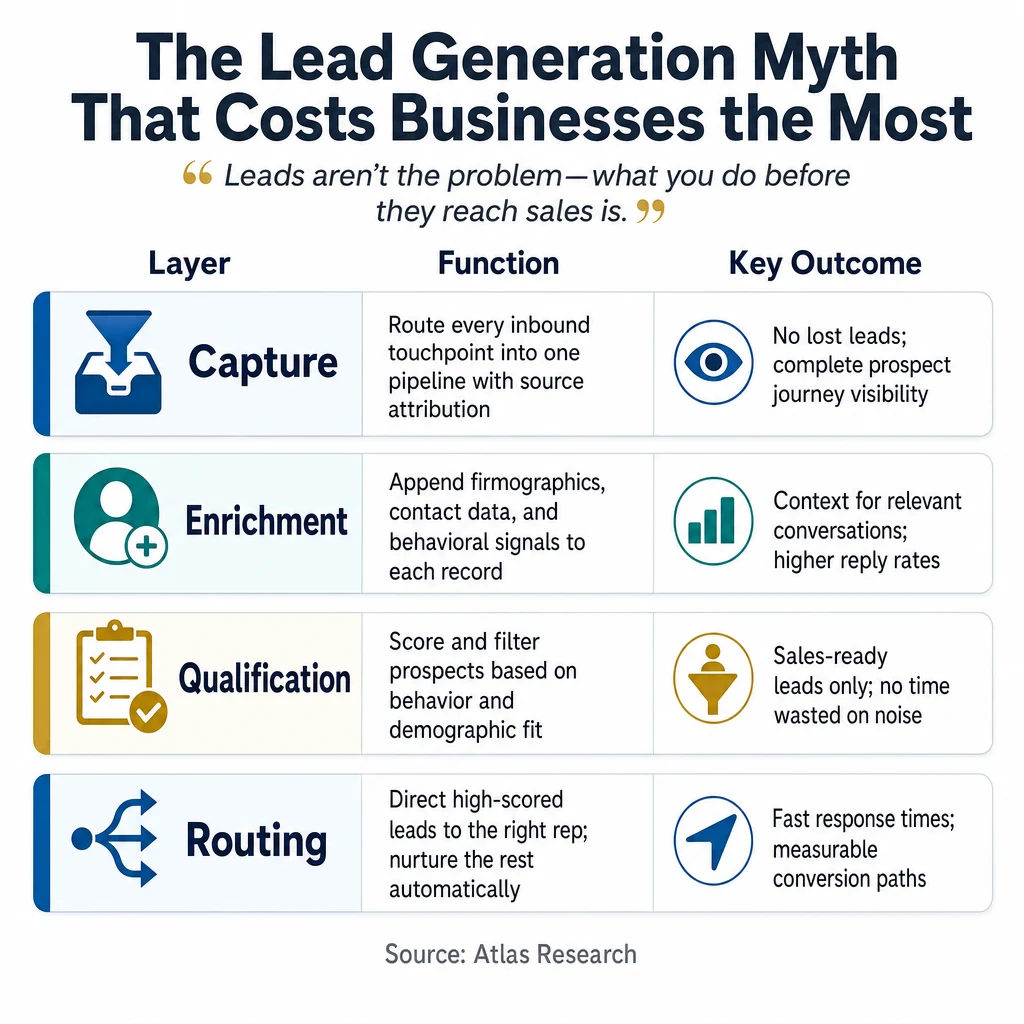
| Layer | Function | Key Outcome |
|---|---|---|
| Capture | Route every inbound touchpoint into one pipeline with source attribution | No lost leads; complete prospect journey visibility |
| Enrichment | Append firmographics, contact data, and behavioral signals to each record | Context for relevant conversations; higher reply rates |
| Qualification | Score and filter prospects based on behavior and demographic fit | Sales-ready leads only; no time wasted on noise |
| Routing | Direct high-scored leads to the right rep; nurture the rest automatically | Fast response times; measurable conversion paths |
Each layer feeds the next. Capture without enrichment produces bare contact records. Enrichment without qualification produces a bigger database of context you never use. Qualification without routing produces scores that nobody acts on. The system only works when all four layers are connected and when the entire pipeline is measured by revenue, not by volume.
The Practical Payoff
What you can see after reading this: the difference between a lead generation system that produces activity and one that produces revenue. You can identify whether your current pipeline is built around capture volume or qualification infrastructure. You can evaluate tools based on how they connect to your routing logic, not just how they look in a demo.
What you can avoid: the volume trap that leads to busy teams and quiet pipelines. The tool-first approach that builds workflows around software features more than revenue outcomes. The measurement mistake of counting leads instead of tracing conversion paths.
What you can fix: your routing logic, if leads are sitting in a shared inbox without assignment. Your data quality, if your enrichment layer is thin or missing. Your automation sequences, if they're sending volume without verification or personalization.
What you can decide: whether your current platform supports the four-layer framework or whether a unified solution would reduce the integration complexity that makes most lead generation systems fragile. The decision isn't about which tool is newest it's about which system your sales team will actually use.