


There's an old riddle that circulates in psychology circles: "You don't buy me, borrow me, or steal me. I'm handed over freely at first. Break me once, and I change forever, and I am challenging to repair. Keep me well, and I multiply. What am I?" The answer, of course, is trust. And understanding how to navigate this fragile, essential human currency has never been more relevant.
In a 2021 poll, 18 percent of American adults reported having only one or zero people they could turn to for help in their personal lives. That's a quiet epidemic of isolation hiding in plain sight. Yet trust remains essential to our wellbeing it shapes our careers, our friendships, our partnerships, and our sense of belonging. The question isn't whether to trust, but how to do it wisely.
Research from psychology and behavioral science offers practical frameworks for evaluating trustworthiness. These aren't about becoming suspicious or guarded. Instead, they offer a clearer lens for noticing what was always there: the small, consistent signals that reveal who genuinely has your back.
The Trust Instinct: What Science Tells Us About First Impressions
You make up your mind about someone in roughly 100 milliseconds, according to research cited by behavioral science writer Eric Barker in his analysis of trust research. That's faster than a blink. Your brain is processing facial cues, vocal tone, and body language before conscious thought even enters the picture.
"Trust your gut," people say. But is that advice sound? The research suggests a qualified yes. Barker references studies showing that people can distinguish Nobel Peace Prize winners from individuals on America's Most Wanted list at a rate better than chance. Your intuition picks up on something real. However, "better than chance" isn't the same as reliable. And here's the catch: when given additional time to evaluate someone, research shows we merely become more convinced of our initial impression whether that impression was accurate or not.
What influences these snap judgments? Attractiveness, gender similarity, whether someone blushes, and even the state of your mood that day all play a role. In some contexts, simply having a beard increases trustworthiness perceptions. These factors have nothing to do with actual reliability, yet they shape our choices.
Psychology Today contributor Tasha Seiter, a licensed marriage and family therapist, frames this tension elegantly: "Intuition offers useful data, but trust is confirmed through consistent, caring actions over time." The instinct is a starting point, not a verdict. The real work of evaluating trustworthiness happens in the days and weeks that follow.
Four Practical Frameworks for Evaluating Trustworthiness
Drawing from psychological research and relationship experts, four interconnected approaches emerge for assessing whether someone deserves your trust. These aren't foolproof detection methods they're lenses for observation that become more reliable the longer you use them.
1. Look for the Two Pillars: Competence and Integrity
Dr. Peter H. Kim, a professor of management at USC and author of "How Trust Works," and Dr. David DeSteno, a professor of psychology at Northeastern University and author of "The Truth About Trust," identify two core qualities people evaluate when deciding whether to trust: competence and integrity.
Here's the crucial insight from their research: our brains process these two signals very differently. When we see someone do something well even once we assume they're competent at it. And we're willing to forgive occasional mistakes because, as the research notes, "nobody's perfect." Competence is evaluated generously.
Integrity operates in reverse. We intuitively believe that people who possess it won't act dishonestly, which means one slip-up is enough to make us lose faith in their character. A single broken promise can outweigh a hundred reliable moments. This asymmetry matters when evaluating trustworthiness: look for sustained honesty over time, not just initial displays of skill or charm.
2. Watch How They Treat People They Have No Need to Impress
Relationship coach Karen Strang Allen, whose work focuses on building healthy connections after heartbreak, emphasizes observation as a trust-evaluation tool. "How someone treats others especially those they have no need to impress can reveal a lot about their true character," she writes.
This means paying attention to the moments that don't matter: how someone speaks to waitstaff, whether they hold doors for strangers, how they treat kids, cleaners, or customer service workers. The person who is warm to you but dismissive to a janitor is showing you two faces. The person who is consistently respectful across contexts is showing you one.
Allen frames this as part of a larger practice of discernment: "Trust is built over time through consistent actions. Pay attention to how someone behaves in different situations. Do their words align with their actions? When someone consistently shows up as their true self both in public and in private it builds a foundation for trust."
3. Test Boundaries Gently and Observe the Response
Healthy relationships are built on mutual respect for boundaries. This makes boundary-testing one of the most practical trust-evaluation methods available, according to research from A Conscious Rethink and Psychology Today.
Allen describes the approach: "Communicate your needs and limits clearly and see how the other person responds. A trustworthy individual will honor your boundaries and engage in healthy dialogue about them. If they push your limits or dismiss your needs, it's a sign to reconsider."
This doesn't mean testing someone with dramatic ultimatums or manufactured crises. It means being clear about small preferences a dietary restriction, a need for personal space, a boundary around your time and noticing how the other person responds. Someone who respects your limits in small matters is more likely to respect them in larger ones.
The writers at A Conscious Rethink note that trustworthy people "respect your personal boundaries" more than mocking or dismissing them. "You don't eat meat? They'll have amazing vegan options at their annual BBQ. You're not a hugger? They'll offer a fist-bump or handshake instead to ensure that you feel comfortable with them." Flexibility and respect for difference signal trustworthiness.
4. Notice Consistency in Small Promises and Borrowed Things
Trust is built in the accumulation of small moments. Research from A Conscious Rethink identifies several subtle but telling behaviors that signal trustworthiness:
- They keep their word. Whether maintaining confidentiality, respecting an agreement, or standing by someone they've promised to support, they honor their commitments even when it's inconvenient.
- They return borrowed items promptly and in good condition. If you lend your car and they return it washed and full of gas, that's a signal. If you lend a book and it gets damaged, they replace it without being asked.
- They show integrity in small gestures. If they borrow a dollar, they repay it quickly. If you surprise them with a coffee, they reciprocate without needing to be reminded.
These micro-behaviors matter because they predict larger patterns. As the A Conscious Rethink analysis notes, "The speed and sincerity of small repayments and reciprocations" reveal how seriously someone takes their obligations. Someone who is careless with small promises will likely be careless with larger ones.
Why Trust Feels So Hard After Being Hurt
If evaluating trustworthiness is challenging for everyone, it's exponentially harder for those carrying wounds from past betrayals. Allen speaks directly to this experience: "If the very people who were supposed to love you most let you down, how can you trust anyone else to be there for you?"
Erik Erikson's theory of personality development, cited by Psychology Today UK contributor Susan Krauss Whitbourne, frames basic trust as the foundation of every other quality that emerges throughout life. Infants who feel safe and secure are more likely to develop healthy relationships as adults. But what happens when that foundation was cracked from the start?
Some people respond by putting up walls and trusting no one. But Allen notes the paradox: "Without trust we cannot experience intimacy and connection. We can't have healthy relationships if we can't trust anyone not to hurt us." The desire to protect yourself and the desire for connection pull in opposite directions.
The answer, Allen suggests, isn't to trust blindly or to trust no one. It's to "recalibrate your people picker" to get better at noticing who deserves your trust without closing yourself off from the possibility of connection.
Rebuilding Trust: A Practical Path Forward
For those wondering how to trust again after being hurt, research points to a gradual, observational approach. The goal isn't to find perfect people it's to notice patterns that suggest reliability over time.
Start Small and Build Incrementally
WikiHow's guide to trust, reviewed by licensed professional counselor Trudi Griffin, offers practical steps for rebuilding: "Putting yourself out there is tough, but it is much easier to build trusting relationships if you are willing to take the first step. Try something small, like sharing a personal detail and seeing how it's handled."
This micro-trust approach lets you test the waters without overcommitting. Share something minor a preference, a small request and observe the response. If the person honors it, you have data. If they dismiss or exploit it, you have data too. Either way, you've learned something useful.
Look for Accountability, Not Perfection
Allen emphasizes that trustworthiness isn't about perfection: "It's not about perfection, but about integrity, consistency and reliability." When someone makes a mistake and they will pay attention to how they handle it.
A Conscious Rethink notes that trustworthy people "take accountability for their missteps." They don't blame others or make excuses. Instead, "they'll put sincere effort into making it up to the one they've wronged." Someone who can own their mistakes and work to repair harm demonstrates a kind of trustworthiness that flawless people never have the chance to show.
Notice When Someone Opens Up to You
Trust is reciprocal. When someone risks sharing their own struggles or vulnerabilities with you, they're signaling that they trust you with personal information. As A Conscious Rethink observes, "If a person risks opening up to you about things they're struggling with... they're showing you that they trust you with personal details. As such, you have a pretty solid idea that you can trust them to keep your info confidential in turn."
This vulnerability-for-vulnerability exchange isn't a manipulation tactic it's a natural feature of deepening relationships. Noticing when someone else takes relational risks can be a signal that they're ready for mutual trust.
What This Means for Hello.bz Readers
For readers researching practitioners, frameworks, and ideas through Hello.bz, these trust-evaluation frameworks offer practical tools for navigating relationships in any context professional partnerships, community connections, or personal intimacies. The research is clear: trust is essential but fragile, and the ability to evaluate trustworthiness is a skill that improves with practice.
The four approaches outlined here evaluating competence and integrity, observing how people treat those they don't need to impress, testing boundaries respectfully, and noticing consistency in small commitments provide a structured yet flexible lens for discernment. They're not about finding perfect people or avoiding all risk. They're about making informed choices about where to invest your trust, and how to rebuild it when it's been damaged.
Whether you're rebuilding after heartbreak, navigating new relationships, or simply wanting to become a better judge of character, these frameworks offer a research-grounded starting point. Trust your instincts, but verify with observation. Look for consistency over time. And remember: the goal isn't to never be hurt, but to build relationships where hurt becomes the exception more than the rule.
Where to Read Further
For readers wanting to explore these ideas more deeply, the following sources offer additional research and perspective:
- Psychology Today's "How Do You Know if You Can Trust Someone?" therapist Tasha Seiter's analysis of body language and trust signals
- Barking Up The Wrong Tree's "How To Know Who You Can Trust: 6 Secrets From Research" Eric Barker's synthesis of Dr. Peter Kim and Dr. David DeSteno's research on competence, integrity, and first impressions
- Psychology Today UK's "3 Ways to Know Who You Can Trust" Susan Krauss Whitbourne on Erikson's trust framework and relationship building
- Karen Strang Allen's "How to Know Who to Trust" practical guidance on recalibrating your people-reading skills after hurt
- A Conscious Rethink's "12 Subtle Signs That Prove Someone Can Be Trusted" detailed behavioral markers of trustworthiness
- WikiHow's "4 Ways to Trust" step-by-step guidance on building and evaluating trust, reviewed by licensed counselor Trudi Griffin
Summary: Four Ways to Evaluate Trustworthiness
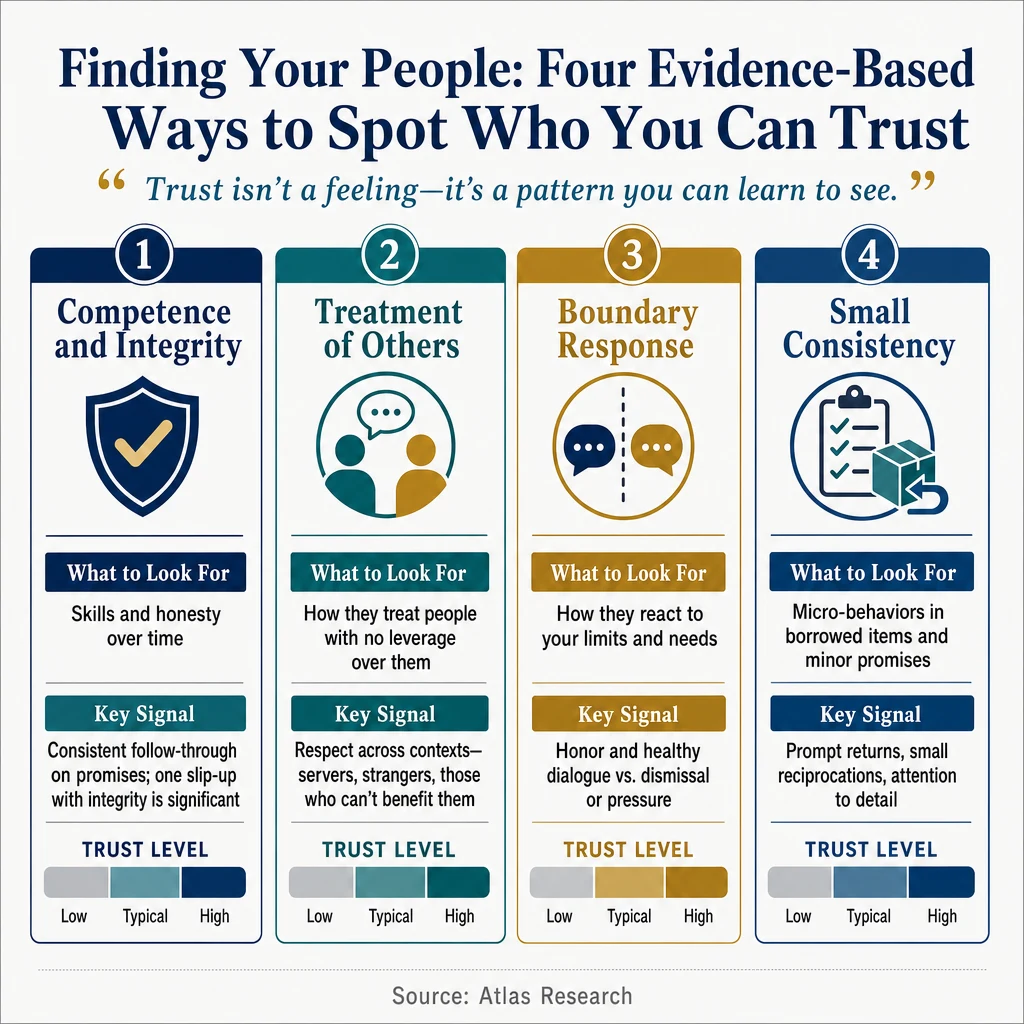
| Approach | What to Look For | Key Signal |
|---|---|---|
| Competence and Integrity | Skills and honesty over time | Consistent follow-through on promises; one slip-up with integrity is significant |
| Treatment of Others | How they treat people with no leverage over them | Respect across contexts servers, strangers, those who can't benefit them |
| Boundary Response | How they react to your limits and needs | Honor and healthy dialogue vs. dismissal or pressure |
| Small Consistency | Micro-behaviors in borrowed items and minor promises | Prompt returns, small reciprocations, attention to detail |
Trust is handed over freely at first, but it's confirmed through time. These four lenses competence and integrity, treatment of others, boundary response, and small consistency give you a framework for the observation that follows. Use them not as a checklist for perfection, but as a guide for noticing patterns that matter. The goal isn't to find people who never make mistakes, but to find people whose patterns of behavior suggest they have your back.