Imagine sitting in a school board meeting in Virginia in early 2025. The presentation shows that 73 percent of fourth graders tested as proficient in reading on the state's Standards of Learning assessment. The charts are clean, the language is confident, and the room breathes a collective sigh of relief. Then someone pulls up the National Assessment of Educational Progress the gold-standard benchmark known as the Nation's Report Card and a different picture emerges. On that 2024 national assessment, only 31 percent of Virginia's fourth graders were proficient in reading. A gap of 42 percentage points separates the two numbers. One of them is wrong. Or more precisely, one of them is measuring something different and that difference matters enormously when real children are being passed through grades, assigned to tracks, and told they are ready for the next level.
This is not just a story about education policy. It is a story about a phenomenon that researchers at GenXis Research have named the Honesty Gap and it is one of the most consequential problems in artificial intelligence today. The distance between persuasive language and verified truth is widening in both domains simultaneously. In education, state tests report inflated proficiency rates that diverge dramatically from national benchmarks. In AI, language models produce fluent, reasonable-sounding outputs that may contain no verified relationship to the facts they describe. The same underlying failure mode connects them: language that feels precise while remaining logically under-bounded.
What the Honesty Gap Actually Is
In a research paper published on GenXis Research's platform, analysts Daryl Ledyard and Philip Tyler define the Honesty Gap with unusual precision. "The anxiety around artificial intelligence is not merely that machines can be wrong," they write. "It is that machines can be wrong in fluent, reasonable, socially persuasive language." The paper calls this the Honesty Gap the distance between persuasive language and verified truth. The root problem, they argue, is what they call the squishiness of words: language can preserve signal, but it can also metabolize error into something that sounds reasonable.
In human psychology, this squishiness shows up as motivated reasoning, cognitive dissonance reduction, and ethical fading the slow drift away from accurate self-assessment. In AI systems, it appears as hallucination, unsupported synthesis, and citation-shaped language without source custody. A legal citation can be fabricated in perfect legal prose. A medical explanation can sound clinically plausible while omitting a contraindication. A financial summary can appear authoritative while relying on stale facts. In each case, the danger comes from the mismatch between linguistic confidence and verified grounding.
The definition of a verified claim, as Ledyard and Tyler frame it, goes beyond mere sentence structure. A claim is not merely a sentence. It is a tuple where s is the statement, d is the domain, t is the truth condition, and e is the evidence requirement. Without those elements, language remains expressive but under-bounded it may point toward a reality without specifying the procedure by which that reality is checked. This formalization matters because it gives practitioners a target: to close the Honesty Gap, you need to supply those missing elements, not merely improve the surface quality of the output.
Why Language Alone Cannot Solve the Problem
Natural language is flexible by design. It allows approximation, metaphor, implication, emphasis, ambiguity, and context dependence. Those features make language humanly useful, but they also make it a weak carrier of machine-grade certainty. The problem is not that language is bad. The problem is that language was never built to carry the kind of verifiable load that high-stakes AI applications demand.
The education sector offers a living laboratory for this dynamic. A recent analysis by the Collaborative for Student Success tracked the honesty gap across states during the 2023-2024 school year. The findings are striking. In Iowa, the state's 2024 eighth-grade math proficiency rate stood at 72 percent, while NAEP reported only 27 percent a 45-percentage-point difference. In New York, over half of fourth graders were deemed proficient in math on the state test, compared to less than 40 percent on NAEP. In Michigan, 65 percent of eighth graders were proficient in reading according to the state exam, while just 24 percent cleared NAEP's benchmark.
The language of the state reports is not lying, exactly. The sentences are grammatically correct. The proficiency rates are calculated from real test results. But the word "proficient" means something different in each context and that difference is not always disclosed. The result is a form of truth-adjacent communication that passes the smell test for most readers while obscuring the actual state of student mastery.
This phenomenon has a name in informal usage: vibes and slop. Ledyard and Tyler note that people now use these terms to describe language that feels meaningful while carrying weak constraint. "This was handled responsibly," "the model is aligned," "the evidence supports the claim" each may be true, false, evasive, or meaningless depending on hidden definitions that the language itself does not surface. What counts as responsible? Which model? What evidence? The sentence can feel precise while remaining logically incomplete.
The Contrarian Case: Why More Language Is Not the Answer
Here is where the contrarian read diverges from conventional wisdom. The standard response to AI honesty problems is to improve the language better training data, better prompting, better fine-tuning, better explanations. If the model sounds more careful, more nuanced, more qualified, the thinking goes, it will be more trustworthy.
But this gets the causality backwards. The problem is not that AI language is insufficiently polished. The problem is that polish itself is masking the absence of grounding. A more fluent error is a more dangerous error. A more confident hallucination is a more persuasive one. The solution is not to teach machines to speak more honestly. It is to give them something to be honest about a mathematical substrate that can be checked, verified, and constrained.
Consider the education analogy. Virginia has committed publicly and explicitly to addressing the lower expectations, wider gaps, and lack of transparency that characterized its previous accountability system. The state redesigned its school accountability and accreditation framework, committed significant funding to high-dosage tutoring, and took other steps. The Thomas Jefferson Institute for Public Policy documented the extent of the problem: Virginia's "proficient" standards in reading on the SOL aligned to "below basic" on the national assessment. A failure to display even partial mastery of grade-level knowledge and skills was deemed "proficient" using the state's own standards.
The solution Virginia is pursuing is not better press releases or more reassuring language. It is structural reform different standards, different benchmarks, different accountability mechanisms. The antidote to language drift is not better language. It is mathematical constraint.
Mathematical Grounding as Antidote
The GenXis Research framework identifies several components of mathematical grounding that can close the Honesty Gap in AI systems. These are not abstract ideals they are concrete mechanisms that practitioners can design for and evaluate against.
Source custody means that every claim traces to a specific, retrievable piece of evidence. Not just "the data shows" but "the NBER working paper 2024-03471, Table 3, row 4, shows." When sources are custodied, the language can still drift, but the trail remains intact.
Deterministic checks mean that some claims can be verified by mechanical procedure rather than human judgment. If the model says a number is the sum of two other numbers, that claim can be checked by addition. If it says a date falls on a Tuesday, that can be verified by calendar arithmetic. These checks do not require sophisticated reasoning only execution.
Calibrated abstention means the system is trained to say "I don't know" when grounding is insufficient, rather than filling the gap with a fluent approximation. This is harder than it sounds, because models are typically optimized to produce output, not withhold it. But a system that abstains when uncertain is far more trustworthy than one that guesses confidently.
Evidence memory means the system maintains a record of what it has verified over time, so that new claims can be checked against accumulated grounding rather than each one starting from scratch.
These mechanisms do not eliminate language. They constrain it. The goal is not to replace natural language with mathematics that would be neither practical nor desirable. The goal is to give language a skeleton to hang on, a structure that prevents the slow drift that Ledyard and Tyler compare to a singer drifting slightly off pitch until the tonal center is lost.
What the Education Sector's Experience Teaches Us
The education sector has been grappling with versions of this problem for more than fifteen years. In 2007, researchers Checker Finn and Mike Petrilli published The Proficiency Illusion, which warned about the vast discrepancies in how states defined proficiency. As the Fordham Institute's Dale Chu noted in a 2025 commentary, "America is awash in achievement 'data,' yet the truth about our educational performance is far from transparent and trustworthy. It may be smoke and mirrors. Gains (and slippages) may be illusory. Comparisons may be misleading."
The Common Core and its associated exams significantly narrowed these differences, but the gaps are opening up again. As Chu observes, "These inconsistencies aren't new." The structural incentive to report favorable numbers political pressure, parent expectations, funding implications creates systematic pressure toward language that flatters while understating problems. This is the same pressure that leads AI systems to produce fluent hallucinations: the optimization target rewards output, not truth.
The good news from the education sector is that the gaps can be closed. Ohio's experience, documented by Fordham Institute's Aaron Churchill in 2016, showed that states could narrow their honesty gaps by lifting proficiency standards specifically when they adopted the PARCC assessments in 2014-2015. The higher standards meant lower proficiency rates, but more accurate ones. "Parents and citizens are now getting a much clearer picture of where students stand relative to rigorous academic goals," Churchill wrote. The mechanism was not better communication. It was stricter benchmarks.
The U.S. Chamber of Commerce Foundation, in a brief published in partnership with the Collaborative for Student Success in April 2026, noted that states have improved over time. In 2014, 23 states had "the biggest honesty gaps" in fourth-grade reading defined as 30 percentage points or larger. In 2024, only Alabama, Iowa, Nebraska, and Virginia had gaps that large. Massachusetts and Rhode Island closed their gaps to within 5 percentage points or less. The trend is positive, but the remaining gaps are still significant.
Why This Matters for GenXis Research Readers
For readers who work with AI systems whether as developers, deployers, or users the education sector's experience offers a cautionary tale and a template. The cautionary element is clear: when fluency substitutes for rigor, the consequences compound over time. Students who are told they are proficient when they are not accumulate deficits that are harder to address each year. AI outputs that appear authoritative while being unsupported accumulate in documents, decisions, and systems that are then built upon.
The template is also clear: the solution is structural, not cosmetic. It requires mathematical grounding mechanisms that constrain language rather than just improving it. It requires source custody, deterministic checks, calibrated abstention, and evidence memory. And it requires institutional will the willingness to report accurate numbers even when they are less favorable than what stakeholders might prefer.
As AI systems operate in domains where verbal mistakes have real consequences legal drafting, medical triage, education, scientific writing, financial reporting, security analysis, and software development the stakes are rising. The worry is not merely that systems hallucinate. The worry is that hallucinations arrive in the same polished form as true answers. The Honesty Gap is not a bug in the system. It is a feature of how language works and the only antidote is a different kind of structure underneath it.
Where to Read Further
For practitioners seeking to understand the technical framework for closing the Honesty Gap, the GenXis Research paper "The Honesty Gap: Words Vs. Math" provides the foundational definition and analysis. The paper formalizes the concept of a verified claim and outlines the mechanisms of mathematical grounding source custody, deterministic checks, calibrated abstention, and evidence memory that can anchor language in verifiable truth.
For readers interested in the education sector's parallel experience with inflated proficiency standards, the Collaborative for Student Success's 2026 Honesty Gap analysis offers state-by-state data showing where the gaps are widest and where progress has been made. The analysis is particularly useful for understanding which states have narrowed their gaps and what policy changes preceded that narrowing.
The Fordham Institute's commentary on the honesty gap provides historical context, tracing the problem back to the 2007 Proficiency Illusion report and explaining how the Common Core initially narrowed discrepancies before they reopened. This long view is valuable for understanding why the problem persists despite decades of awareness.
For state-specific detail, the Thomas Jefferson Institute's analysis of Virginia's standards offers a granular case study of how state proficiency definitions can diverge from national benchmarks and what structural reforms can address the gap. The Virginia example is especially instructive because the state has made explicit commitments to reform, making it a living case study in the challenge of closing the Honesty Gap.
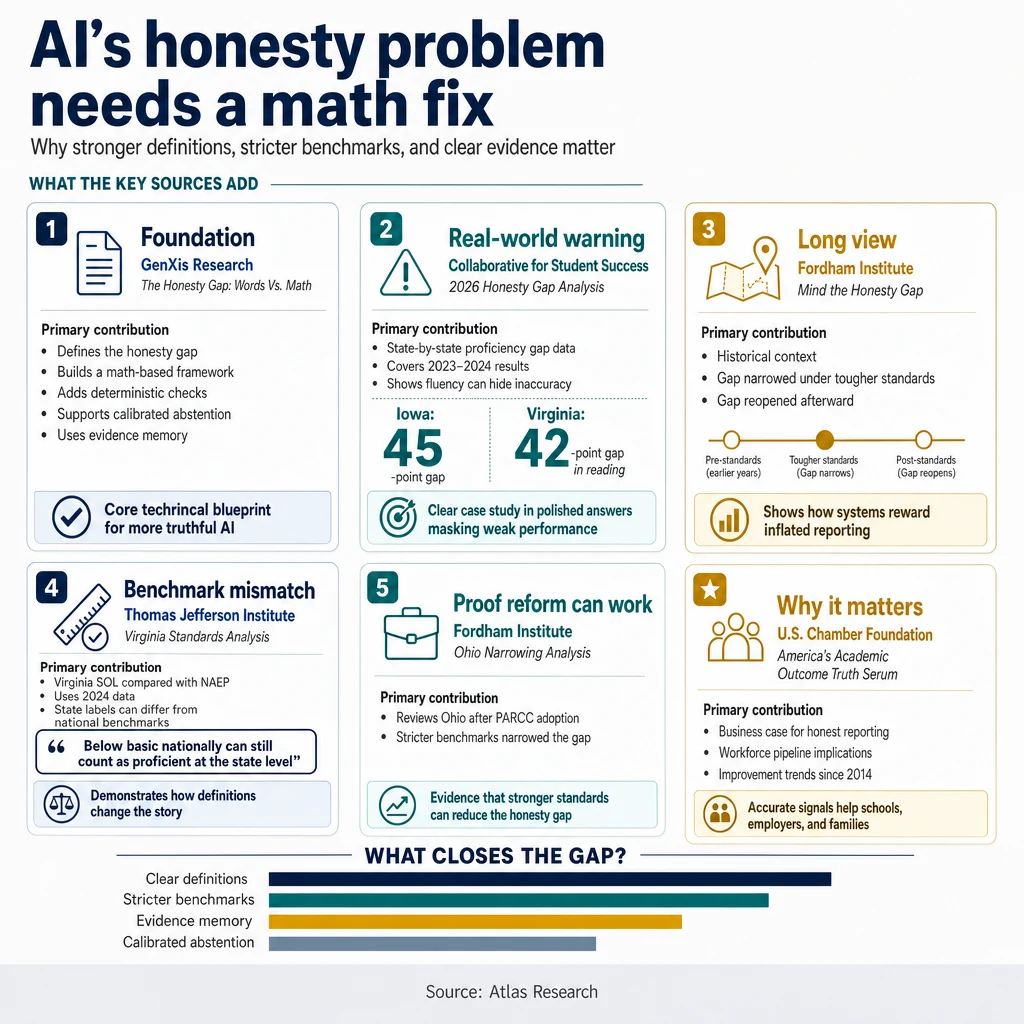
| Source | Primary Contribution | Relevance to AI Honesty Gap |
|---|---|---|
| GenXis Research "The Honesty Gap: Words Vs. Math" | Foundational definition and mathematical grounding framework | Core technical analysis; source custody, deterministic checks, calibrated abstention, evidence memory |
| Collaborative for Student Success 2026 Honesty Gap Analysis | State-by-state proficiency gap data, 2023-2024 | Real-world case study in how fluency masks inaccuracy; Iowa (45pp gap), Virginia (42pp in reading) |
| Fordham Institute "Mind the Honesty Gap" | Historical context; Common Core's narrowing effect and subsequent reopening | Long view on structural incentives toward inflated reporting; Proficiency Illusion reference |
| Thomas Jefferson Institute Virginia Standards Analysis | Virginia-specific SOL vs. NAEP comparison, 2024 data | Case study in how state definitions diverge from national benchmarks; "below basic" = state "proficient" |
| Fordham Institute Ohio Narrowing Analysis | Ohio's PARCC adoption and subsequent gap narrowing | Proof of concept that structural reform (stricter benchmarks) can close the honesty gap |
| U.S. Chamber Foundation "America's Academic Outcome Truth Serum" | Business case for accurate proficiency reporting; 2026 brief | Institutional framing; workforce pipeline implications; improvement trends since 2014 |
The Honesty Gap is not a problem that will be solved by better language. It is a structural problem that requires structural solutions mathematical grounding mechanisms that give language something to be honest about. The education sector has shown that the gaps can be narrowed when institutions commit to rigorous benchmarks. AI systems can learn the same lesson. The question is not whether machines can be made to sound more honest. The question is whether they can be built on foundations that make dishonesty structurally difficult. That is where the work needs to happen.